
PET Strapping for Corrugated Boxes & Cartons
Strapping may bundle corrugated packs or help unitize palletized cartons for handling and distribution. The package must withstand the applied tension and local contact at edges without unacceptable crushing or movement. PET can be considered for appropriate industrial unit loads, while PP may meet the requirements of lighter applications. Start from carton construction, pallet configuration and the actual equipment, rather than assuming that a stronger strap makes a better carton package.
Explore the application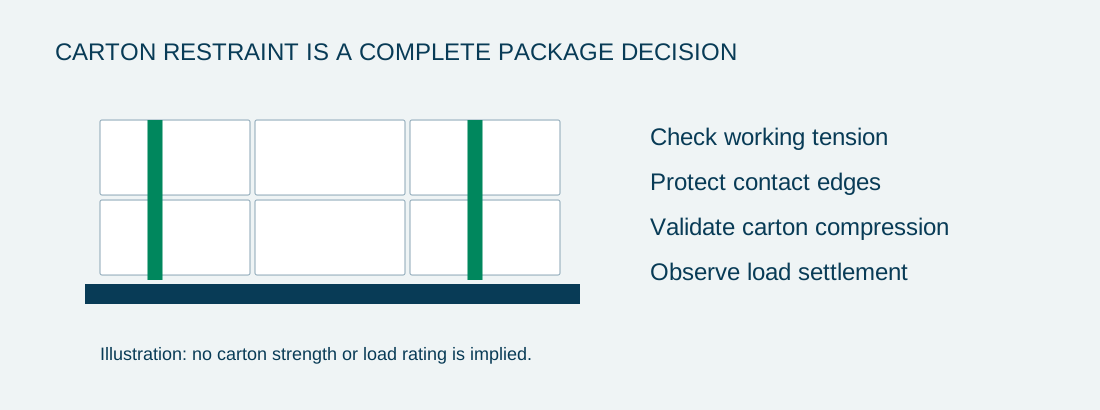
Is PET Strapping Right for Corrugated Cartons?
PET may be appropriate where the unit load needs its specified restraint behavior and the cartons, protective components and equipment tolerate the proposed tensioning system. Carton strength, moisture condition, compression, settlement and edge-crushing risk all affect the decision.
A larger pallet does not by itself establish the correct material. Define the required package outcome, then compare qualified PET and PP systems. Do not use strap tension to compensate for a carton or pallet configuration that lacks adequate support.
What Matters Most?
| Factor | Carton-specific review |
|---|---|
| Working tension | Enough restraint without unacceptable panel deformation or edge loading. |
| Strap width and surface | Actual contact distribution and compatibility with the tool/head. |
| Edge protection | Support at corners; check movement or crushing of protective components. |
| Carton compression | Board strength, construction, moisture, stacking and settlement. |
| Joint | Consistent closure without slip or damage at the overlap. |
| Machine compatibility | Feeding, gripping, tension control, weld settings and coil format. |
Review the finished unit load, not just the parent strap. Product fragility and surface-marking limits may require additional packaging design work.
PET vs PP for Cartons
PP may be sufficient for lighter cartons or bundles when the qualified grade, joint and handling duty meet the requirements. PET should not be specified solely because Newton manufactures it. PET may be a candidate where a palletized carton system needs different restraint or mechanical behavior, provided compression and equipment conditions are validated.
Compare actual grade data, working tension, settlement and total packaging cost. A higher specimen breaking force is not permission to apply greater tension to a pressure-sensitive carton.
How to Choose Strap for Carton Packaging
- Record carton dimensions, board/construction details, contents and any compression/marking restrictions.
- Describe pallet layout, stacking height, support, edge protection and other unitizing materials.
- Document the present strap, tension, joint and machine/tool model.
- Compare PET and PP candidates against the same package criteria.
- Check the approved dimensions, coil format and tension/sealing controls.
- Trial realistic cartons and production settings; inspect after relevant storage and handling.
Machine-Grade PET Strapping for Carton Lines
A carton line must be explicitly approved for the proposed PET consumable. Many installed machines have material- or dimension-specific restrictions. Feeding also depends on camber, curl, stiffness, track condition and dispenser behavior, while welding depends on surface, overlap and settings.
Review NewtonStrap Plus as a starting point for a machine-grade enquiry, not as a universal line approval. Request a written grade specification and test feeding, low-tension control, made joints and the actual package before approving supply.
Avoiding Carton Damage
Excessive tension and concentrated edge contact can deform cartons or damage their contents. Inspect panels, corners and the support under the strap path; check whether protective components distribute contact without shifting. More straps or wider strap are not automatic fixes without reviewing the complete design.
Observe the package immediately after tensioning and after settlement or conditioning relevant to the shipment. Record applied settings, carton condition and any movement. Investigate whether damage originates in unsupported stacking, moisture, tension control or contact geometry before changing strap grade.
Validation Checklist
- Representative carton construction, moisture condition, contents and pallet configuration.
- Approved strap dimensions, material, surface and coil/core.
- Controlled tension and joining settings with the intended equipment.
- No unacceptable carton crushing, marking or content damage.
- Consistent feeding, retraction, joint formation and cutting.
- Adequate package restraint after relevant settlement and handling.
- Documented observations, lot identity and approval criteria.
FAQs
Is PET strapping suitable for corrugated boxes?
PET can be suitable for selected carton bundles or palletized carton loads when the package tolerates the proposed restraint system. Carton strength, contact pressure, settlement, joints and equipment must be reviewed together. PP may be sufficient for lighter applications. Validate the actual cartons and handling duty rather than assuming PET is necessary or better for every box.
Is PP better than PET for cartons?
PP may be the better practical choice where it meets the carton’s closure, handling and cost requirements without unnecessary capability or equipment changes. PET may suit other validated unit loads. Compare working tension, compression sensitivity, restraint after settlement, joints and machine behavior. Neither material should be selected solely from the carton weight or a general marketing claim.
Can PET strapping crush a carton?
PET strapping can contribute to carton damage if applied tension or edge contact exceeds what the package can tolerate. Damage also depends on carton construction, support, moisture and pallet layout. Review controlled tension settings and contact protection, then inspect realistic packages through relevant storage and handling. A stronger or wider strap alone does not guarantee less damage.
Does wider strap always protect carton edges?
Wider strap does not automatically protect carton edges or resolve package damage. Contact geometry, tension, unsupported panels and protective components influence local loading, and a wider grade must still fit the equipment. Evaluate any width change with the complete carton and pallet configuration. Confirm machine approval and package results rather than inferring protection from nominal width alone.
Can an existing PP carton machine run PET?
An existing PP carton machine needs explicit PET approval before a material change. The installed head, material/dimensional window, feed path, tension controls and welding system may restrict compatibility. Check the manufacturer’s instructions and proposed coil format, then conduct a controlled trial. The fact that both consumables are plastic strap does not establish interchangeable settings or operation.
What should a carton-line trial record?
A carton-line trial should record the carton and pallet configuration, strap grade/lot, machine/head model, settings, feeding and joint results, and any package damage or movement. Evaluate representative operating conditions and relevant settlement or handling. Set acceptance criteria in advance so that a brief successful run or an attractive finished package does not become an unsupported production approval.
Review Your Carton and Pallet Configuration
Send Newton carton dimensions, pallet configuration, current strap and machine information. Include compression or marking restrictions and the handling route so that material and package requirements can be reviewed together.
Technical Scope and Evidence
This guide describes selection principles and evidence to request. It is not a Newton grade data sheet, package load rating or equipment approval. Confirm the proposed grade, test basis and actual application before ordering.
For the test and measurement framework, see breaking-force and joint evidence and dimensions and process consistency.