
What PET Strapping Is Made From
PET is polyethylene terephthalate, a thermoplastic polyester. Packaging strap may use virgin resin, suitably processed recycled PET or a blend. The feedstock source, material condition, processing and verification influence the finished product; a green or black color does not identify the recycled percentage.
A product made with recycled PET and a used strap accepted for recycling are different facts. Ask for evidence for both if they matter to procurement, sustainability reporting or receiving-site waste operations.
For the base polymer and packaging terminology, review what PET strapping is.
Can PET Strapping Be Recycled?
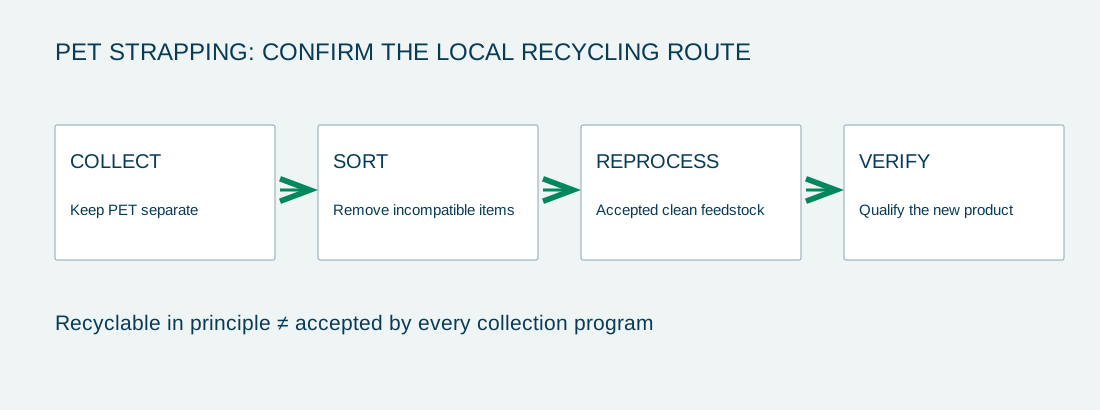
PET strapping can enter a recycling process where a recycler accepts that specific material stream. Check polymer separation, permitted colors, labels, metal seals, contamination, minimum quantities and collection format before setting up bins or making a claim. Do not assume a household bottle program accepts industrial strap.
An operating example is F+M Recycling, which describes collection and processing of used PET/PP bands. Its service demonstrates a possible industrial route, not universal availability or a Newton take-back program. Arrange acceptance and commercial terms for your actual site and destination.
How PET Strapping Recycling Works
- Collection: capture used strap in a designated container after controlled removal from the load; keep loose loops out of walkways and machinery.
- Separation: identify PET and keep it separate from PP, steel and other waste according to the recycler’s instructions.
- Removal of incompatible materials: handle seals, labels and mixed packaging as agreed with the processor. Do not improvise unsafe manual separation.
- Cleaning: the receiving process may include washing to address dirt, residues and other contaminants; limits and treatment vary.
- Reprocessing: accepted material can be size-reduced and processed into flakes or other feedstock, with appropriate sorting and quality controls.
- Reuse: qualified recycled feedstock may be made into new products, potentially including strap. That is reprocessing, not permission to re-tension or reuse the original loaded strap.
Recycled PET Strapping vs Virgin PET Strapping
Recycled origin does not automatically mean lower finished-strap quality, and it does not automatically establish equivalence to virgin PET. Material condition, contamination control, purification, molecular-weight preservation, orientation and verification all matter. A virgin feedstock can also be damaged by unsuitable processing.
Compare the released specification, dimensional variation, breaking force, elongation, g/m, joints and machine trials under the same acceptance basis. Request traceable recycled-content evidence separately. Neither appearance nor a polymer-identification test alone proves an exact recycled percentage or a guaranteed application result.
Connect the evidence requirements with Newton’s PET strapping products when comparing candidate material options.
What Can Contaminate PET Strapping Recycling Streams?
- Metal seals or attached metal parts.
- Labels, adhesive residues and incompatible coatings.
- PP strap, film and other mixed plastics.
- Dirt, sand and product residues.
- Oils, chemicals or other hazardous contamination.
- Cardboard, wood, textiles and mixed packaging.
Acceptance thresholds depend on the processor. Obtain written sorting and preparation instructions, including any requirement to remove components and any exclusions for contaminated material. A filtration step does not remove every chemical or reverse polymer degradation.
What Buyers Should Ask a PET Strapping Supplier
- What recycled content is declared for this grade, and what is the calculation boundary?
- How are post-consumer and pre-consumer sources defined and documented?
- Which purchasing, dosing or traceability records support the claim?
- How are incoming material condition and contamination controlled?
- What released dimensions, minimum force, elongation, g/m and joint results apply?
- What lot-consistency evidence and machine trials support the proposed supply?
- Is a take-back or recycling service actually offered for my location?
Newton’s grade-specific recycled-content declaration, supporting evidence and any take-back arrangements: Please confirm this grade-specific value or option with Newton. A brochure statement alone should not be extended to every grade or destination.
Use the PET strapping manufacturer qualification guide to organize supplier evidence and traceability questions.
Best Practices for Industrial Users
- Confirm the recycler accepts PET strapping before calling the stream recyclable at your site.
- Keep PET segregated and label containers so that PP and metal strap do not become mixed.
- Follow controlled cutting and handling procedures; prevent loose loops from reaching equipment.
- Keep accepted material dry and protected from oils, dirt and unrelated waste as the recycler requires.
- Agree how to handle seals and labels and what bale/bag format is accepted.
- Retain collection weights and acceptance records if reporting recovered material.
- Recheck the route when the strap formulation, collection service or destination changes.
For operational packaging requirements, review PET strapping for industrial pallet packaging alongside the collection plan.
FAQs
Is PET strapping recyclable?
PET strapping is recyclable in principle when a processor accepts the specific stream and can sort and reprocess it. Local collection, contamination, color, attached components and commercial arrangements affect the route. Confirm acceptance for industrial strap rather than assuming a PET bottle program will take it. Resin identity alone does not establish actual recycling at your destination.
Can I put PET strap in a household recycling bin?
Do not put industrial PET strap in household recycling unless the collector explicitly accepts it. Accepted product forms vary by location, and long or loose bands may be inappropriate for the collection system. Ask the operator about preparation and a dedicated industrial route. A resin code or the material’s recyclability in principle is not collection permission.
Can PET and PP strapping be recycled together?
PET and PP should not be mixed unless the receiving processor explicitly accepts and separates that mixed stream. They are different polymers, and a recycler may require separately sorted material to meet its feedstock specification. Identify the strap, confirm the processor’s instructions and control collection bins; similar colors or shapes do not make the materials interchangeable.
Does recycled PET strapping have lower strength?
Recycled content alone does not determine the strength of finished PET strap. Feedstock condition, contamination control, processing, orientation and effective section influence results. Compare released minimum breaking force, elongation and joint evidence under equivalent methods, then validate equipment and load behavior. Neither recycled nor virgin origin is a substitute for product-level conformity evidence.
How can a supplier prove recycled content?
A recycled-content claim needs traceable origin and mass-accounting evidence for the stated product and calculation boundary. Ask how post-consumer and pre-consumer material are defined, which records are retained and what any certification actually covers. Color or a basic polymer-identification test cannot independently establish an exact recycled percentage. Confirm the declaration for the proposed Newton grade.
Can used PET strap be tensioned again?
Previously loaded PET strap should not be assumed suitable for direct reuse or re-tensioning. Damage, deformation, joint history and unknown loading can affect its remaining properties. Follow the applicable tool and packaging instructions when restrapping. Recycling used material into newly manufactured and verified strap is a different process from reusing an existing strap on another load.
Does Newton offer a PET strap take-back program?
A Newton take-back service is not confirmed by this guide. Availability would need to be established for the grade, site, collection volume and destination, with an identified receiving processor. Ask Newton about documented material options and your local recycler about acceptance. Do not treat an example from another recycler or manufacturer as a Newton service commitment.
Discuss Documented PET Material Options
Ask Newton for the proposed grade specification, recycled-content evidence and relevant test records. Tell us the destination market and your recycler’s acceptance requirements so that material and end-of-life questions remain connected.
Technical Scope and Evidence
This guide describes selection principles and evidence to request. It is not a Newton grade data sheet, package load rating or equipment approval. Confirm the proposed grade, test basis and actual application before ordering.
- F+M Recycling — An operating example of industrial strap collection and reprocessing; not a Newton take-back service. Accessed October 31, 2026.
For the test and measurement framework, see breaking-force and joint evidence and dimensions and process consistency.