
Filters & Sorting Options
Filter the educational entries by Tool Type, Manual / Pneumatic / Battery / Automatic operation and Tensioning / Sealing / Combination function. Record Strap Width, Strap Thickness, Joint Method and Application in the review worksheet. Sorting changes the directory order; it does not rank brands or offer equipment for sale.
PET Strapping Equipment Snapshot
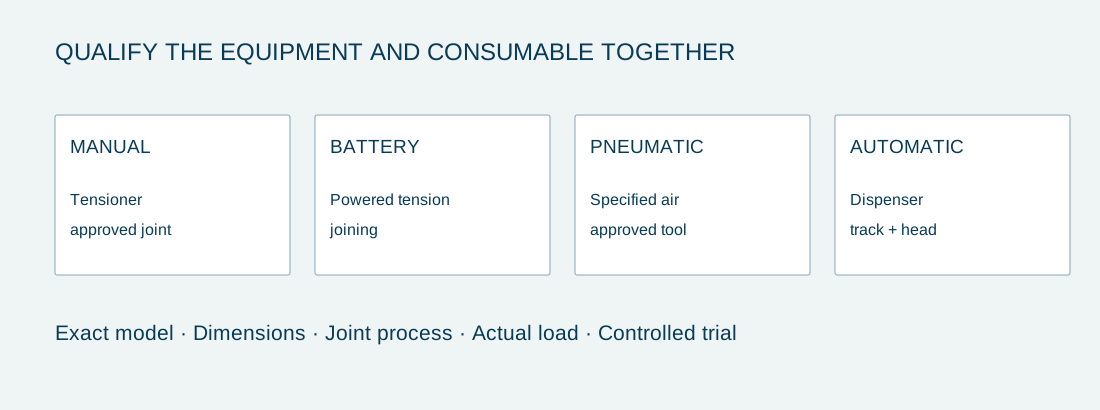
- Manual tensioners apply tension; a separate approved system makes the joint.
- Manual sealers close the specified mechanical seal.
- Combination tools combine operations within a model-specific material range.
- Battery-operated tools can provide powered tensioning and friction welding.
- Pneumatic tools require the specified air supply and maintenance.
- Semi-automatic machines still need explicit PET approval.
- Automatic machines require qualification of strap, dispenser, head and complete packaging cycle.
PET Strapping Tool Types
Manual PET Strapping Tensioner
- Type
- Manual
- Power
- Hand force
- Best For
- Low-volume or mobile work where a separate joining operation is acceptable.
- Compatible Strap Considerations
- Match the gripping mechanism, exact dimensions and strap surface to the approved PET range.
- Joint Method
- Separate approved seal or buckle system; the tensioner does not make the joint.
- Advantages
- Portable and independent of air or battery charging.
- Limitations
- Operator effort and a separate joining step; applied tension needs control.
Manual PET Strapping Sealer
- Type
- Manual
- Power
- Hand force
- Best For
- Closing the specified seals after tensioning with a separate tensioner.
- Compatible Strap Considerations
- Match PET dimensions, seal design and sealer jaws as a system.
- Joint Method
- Mechanical seal crimped with the approved sealer.
- Advantages
- A simple joining option in a compatible manual system.
- Limitations
- Not every metal seal or steel-strap sealer is suitable for PET; verify joint tests.
Manual Combination Tool
- Type
- Manual
- Power
- Hand force
- Best For
- Workstations where a compatible tool combines multiple manual operations.
- Compatible Strap Considerations
- Confirm the tool explicitly supports PET and the required dimension range.
- Joint Method
- Model-specific mechanical joining system.
- Advantages
- Fewer separate tools for an approved setup.
- Limitations
- Supported materials and joining functions vary; do not infer compatibility from the name.
Battery PET Strapping Tool
- Type
- Battery
- Power
- Rechargeable battery
- Best For
- Mobile packaging that benefits from powered tensioning and joining.
- Compatible Strap Considerations
- Check exact model, width/thickness version, tension range and surface approval.
- Joint Method
- Commonly friction welding on approved PET/PP models; verify the exact tool.
- Advantages
- Powered operation without a compressed-air hose.
- Limitations
- Charging, battery condition, cooling, wear and parameter control still matter.
Pneumatic PET Strapping Tool
- Type
- Pneumatic
- Power
- Compressed air
- Best For
- Workstations with suitable regulated air and an approved PET tool.
- Compatible Strap Considerations
- Check material, dimensions, permitted pressure and tension settings in the manual.
- Joint Method
- Often friction welding on relevant PET models; confirm the installed system.
- Advantages
- Powered operation at a fixed production station.
- Limitations
- Air quality, supply capacity, hoses and maintenance affect repeatability.
Semi-automatic Strapping Machine
- Type
- Semi-automatic
- Power
- Model-specific electrical and/or air supply
- Best For
- Operator-assisted packaging where the installed machine is approved for PET.
- Compatible Strap Considerations
- Check the actual feed/retract path, approved PET window and coil/core interface.
- Joint Method
- Installed sealing head and approved material-specific joining process.
- Advantages
- Can automate tensioning and joining within an operator-assisted cycle.
- Limitations
- Many machines are PP-only; semi-automatic does not imply PET approval.
Automatic Strapping Machine
- Type
- Automatic
- Power
- Model-specific line power and utilities
- Best For
- Integrated production with defined load presentation and control interfaces.
- Compatible Strap Considerations
- Confirm PET approval, guides, head, dispenser, package range and line settings.
- Joint Method
- Installed automatic head; welding method and overlap depend on design.
- Advantages
- Repeatable cycles when the full line and consumable are qualified.
- Limitations
- Qualification must cover feeding, stops, coil changes, joints and package variation.
No tool types match these filters.
PET Strapping Tool Size Compatibility
A 1/2 inch, 5/8 inch or 3/4 inch PET strapping tool label names a purchasing category, not permission to use every strap with that nominal width. Exact conversions are 12.7, 15.875 and 19.05 mm respectively. Check whether the tool is built or configured for a particular width and thickness window.
The same tool family can have different guide or jaw versions. Confirm the full model code, material, surface, nominal dimensions and tolerance. For a heavy duty sealer for PET strapping, review seal type and measured joint results as well as jaw size. A portable strapping kit must contain mutually compatible parts, including the dispenser and consumable.
Use the PET strapping sizes directory to record actual dimensions rather than relying on a tool size label.
PET vs PP Tool Compatibility
Some tools and machines are designed for both PET and PP, but the approved dimension and tension ranges may differ. Material changes can require different welding energy, cooling or other settings within the manufacturer’s instructions. A dual-material label does not establish that the same settings work.
For example, FROMM identifies PET and PP among the supported materials of its P328 tool. That is an example of model-specific support, not an endorsement of Newton strap or a universal tool rule. Use the exact model documentation and verify made-joint performance before changing material.
For the broader material decision, compare PET vs PP tool compatibility in the PET-versus-PP guide.
How to Choose a PET Strapping Tool
- Identify actual strap width, thickness, tolerances and surface.
- Define required working tension and package sensitivity; do not substitute specimen breaking force.
- Estimate daily packaging volume, cycle pattern and operator mobility.
- Choose an approved joint type and verify seal/weld performance.
- Check air or electrical supply, charging and workstation access.
- Confirm package geometry, contact area and tool removal clearance.
- Review maintenance, wearing parts and manufacturer support.
- Keep the current approved specification and trial the proposed strap/tool combination.
For the load-side requirements, review PET strapping tools for pallets alongside the complete pallet system.
Why a Tool Can Work With One PET Strap but Not Another
Two straps may share a nominal width yet differ in dimensions, camber, curl, stiffness or surface. Gripping and overlap alignment can change; welding behavior also depends on the grade, settings and tool condition. Coil build affects dispensing and the way strap reaches the workstation.
Investigate the failure location before changing material. Compare strap lots under controlled conditions and check guides, gripping surfaces and maintenance. Do not increase tension or welding time until the tool instructions, actual strap dimensions and failure pattern have been reviewed. For feed-related problems, use the dedicated machine-jamming guide.
FAQs
What tool is used for PET strapping?
PET strapping requires equipment explicitly approved for the proposed strap, which may be a manual tensioner/sealer system, combination tool, battery tool, pneumatic tool or PET-capable machine. Choose from the exact width, thickness, joint method and packaging conditions. This directory describes equipment categories; Newton’s role here is the PET consumable and its application-specific compatibility review.
Can a manual PET strapping tool make a reliable joint?
A manual system can make an acceptable joint when the strap, seal or buckle, tool and operating method are qualified together. The tensioner alone does not establish joint performance. Check the joining components, dimension limits and measured results under a defined method, and train operators against the equipment instructions rather than judging a joint only by appearance.
Are battery PET strapping tools suitable for every strap?
Battery power does not establish material or size compatibility. Check the exact tool model and variant, approved PET width/thickness range, surface, tension range and welding instructions. Confirm overlap and cooling requirements, then evaluate joints on the proposed grade. A successful result with another PET strap or the same brand’s different size is not a blanket approval.
Can a PET strapping sealer be used on steel strapping?
Do not assume a PET sealer is suitable for steel strapping. Strap material, seal geometry, jaw design and required deformation can differ. Use the tool maker’s approved material and joining components, and verify the intended joint. A material conversion may require different equipment rather than a consumable-only change; Newton does not certify an unreviewed tool substitution.
Is a 5/8 inch hand tool suitable for 16 mm PET?
A nominal 5/8 inch hand-tool description does not by itself approve 16 mm PET. Exactly 5/8 inch equals 15.875 mm, and the actual tool may have a model-specific dimensional window. Confirm the permitted width, thickness, guide configuration and surface, then trial the complete strap/joint system using the manufacturer’s instructions.
Can PET and PP use the same strapping machine?
Some machines support both materials, while others support only one. Check the installed head, approved dimensions, tension range, feed behavior and welding settings with the manufacturer. Qualify the proposed material under the actual production conditions. Existing PP operation does not establish PET capability, and matching a nominal width does not make the operating settings transferable.
Does Newton sell strapping tools or kits?
This page does not establish that Newton manufactures or sells tools or kits. Newton provides industrial PET strapping, and equipment categories are discussed to help specify a compatible consumable. Send the actual machine or tool model, present strap and application for review; confirm any separate equipment procurement or service requirement directly with the relevant provider.
Prepare a Strap and Equipment Review
Send Newton the machine/tool model, current strap specification, joining method and application. Include photos of the coil label and any feeding or joint problem. Ask for a proposed PET grade and a defined compatibility trial.
- Review NewtonStrap Plus for automatic applications
- Troubleshoot PET strap feeding problems
- Prepare an automatic-line qualification
- Discuss your machine and current strap
Connect the equipment brief with Newton’s PET strapping products before requesting a candidate consumable.
Technical Scope and Evidence
This guide describes selection principles and evidence to request. It is not a Newton grade data sheet, package load rating or equipment approval. Confirm the proposed grade, test basis and actual application before ordering.
- FROMM P328 manufacturer information — Example of a tool with model-specific PET/PP support; not Newton strap approval. Accessed October 31, 2026.
For the test and measurement framework, see breaking-force and joint evidence and dimensions and process consistency.